
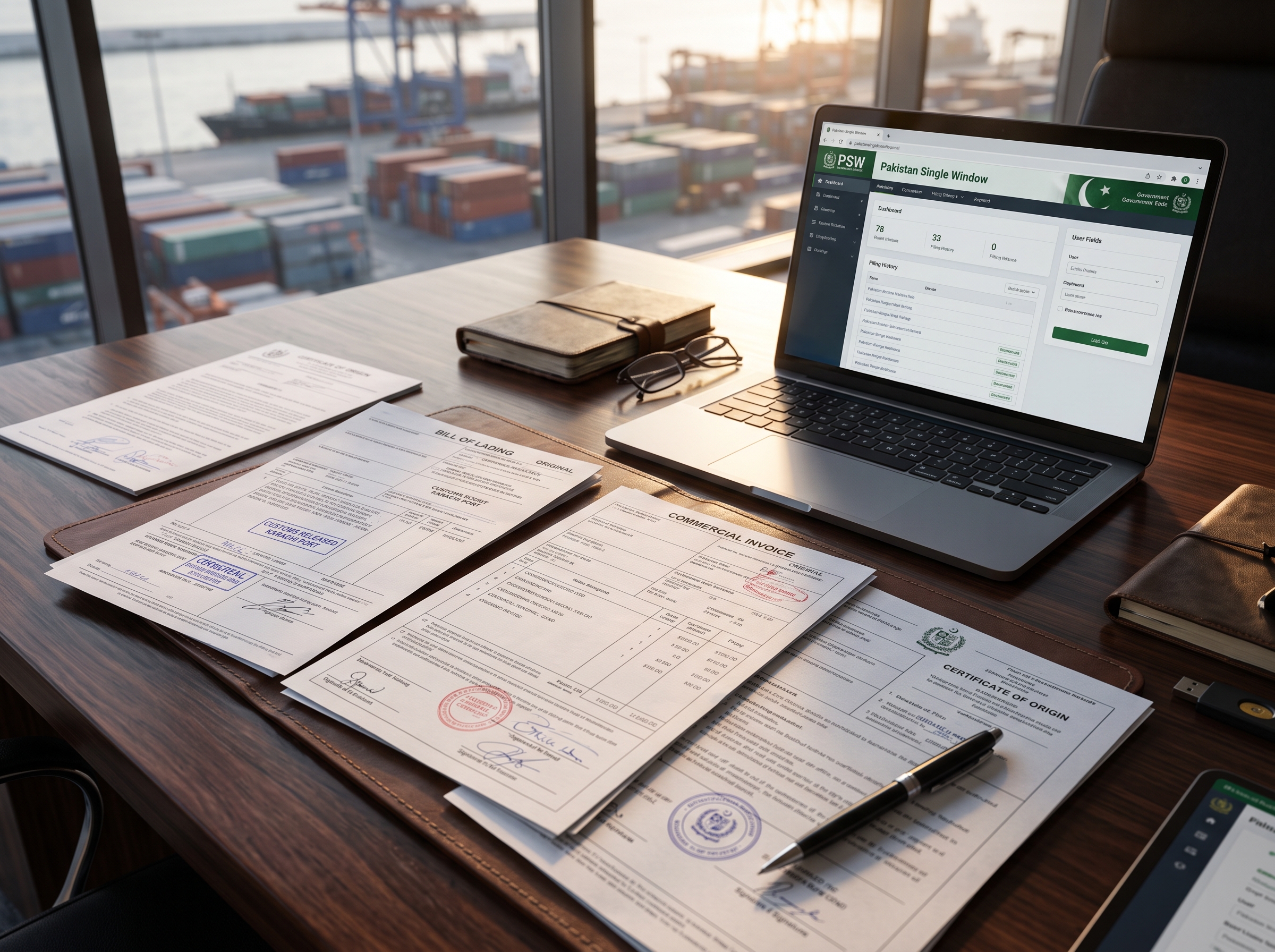
Importing goods into Pakistan can open lucrative horizons for local businesses, manufacturing plants, and commercial traders. Whether sourcing industrial raw materials, metal scrap, heavy machinery, or consumer electronics from global markets like Malaysia, China, or the UAE, your success hinges entirely on one critical operational pillar: proper documentation.
International cross-border logistics is notoriously strict. A single missing stamp, an inconsistent item description, or an unverified HS code can cause your consignment to be flagged at Karachi Port or Port Qasim, resulting in debilitating port demurrage, container detention penalties, or formal legal notices from Pakistan Customs. For this reason, businesses frequently search: documents required for import in pakistan.
Furthermore, as global trade relationships expand, international buyers and overseas investors also frequently ask: what do we import from pakistan? Understanding both sides of this trade corridor—what Pakistan imports from international markets and what the world procures from Pakistan—is crucial for commercial intelligence.
In this definitive guide, we provide an exhaustive, pillar-level breakdown of the documents required for import custom clearance in pakistan. As established B2B supply chain specialists at AM Traders, we manage high-volume cross-border trade daily and are here to equip you with the practical checklist needed for seamless customs clearance.
The Legal Framework for Import Documentation in Pakistan
Under the statutory mandate of the Customs Act, 1969, read alongside the annual Import Policy Order (IPO) issued by the Ministry of Commerce, the Federal Board of Revenue (FBR) oversees all customs procedures across Pakistan.
Today, Pakistan’s import documentation ecosystem is predominantly digital, governed by two interconnected platforms:
- Pakistan Single Window (PSW): The cutting-edge digital trade hub that integrates Pakistan Customs with commercial banks, shipping lines, and over 70 Other Government Agencies (OGAs).
- WeBOC (Web Based One Customs): The computerized customs clearance software where Goods Declarations (GD) are filed, assessed, and processed.
Every document submitted for customs clearance must be authentic, verifiable, and completely aligned across all foreign and domestic trade counterparties.
Stage 1: One-Time Business Documents Required for Importer Registration
Before you can import a single commercial container, your enterprise must be legally recognized as a registered commercial or industrial importer. Pakistan Customs will not allow clearance without an active trader profile.
The essential pre-import registration documents include:
- National Tax Number (NTN) & Sales Tax Registration Number (STRN): Issued by the FBR, your business must be an active taxpayer on the Active Taxpayers List (ATL). Non-filers face punitive withholding tax surcharges at the import stage.
- SECP Incorporation Certificate / Partnership Deed / Sole Proprietorship:
- Private Limited / Public Companies: Certificate of Incorporation and Form II / Form A from the Securities and Exchange Commission of Pakistan (SECP).
- Partnership Firms: Form C and registered Partnership Deed.
- Sole Proprietors: Business registration certificate, official letterhead, and utility bills under the business name.
- Chamber of Commerce & Industry (CCI) Membership: A valid membership certificate from your regional Chamber of Commerce (such as KCCI, LCCI, ICCI, or FCCI) is a mandatory prerequisite for customs registration.
- Commercial Bank Account Maintenance Certificate: A formal certificate issued by a scheduled commercial bank confirming your active business account, authorized signatory, and operational International Bank Account Number (IBAN).
- PSW / WeBOC Digital Profile & Biometric Verification: Completed user profile on the PSW portal backed by biometric verification performed at a NADRA e-Sahulat center by the business owner, CEO, or authorized director.
Stage 2: Core Documents Required for Import in Pakistan (Per-Shipment Checklist)
For every individual consignment that arrives via ocean freight (sea), air cargo, or land border custom stations, the importer must compile and upload the per-shipment core documents. These form the backbone of the Goods Declaration (GD).
Here is the essential master checklist of documents required for import in pakistan:
1. Commercial Invoice (Original)
The Commercial Invoice is the primary financial and commercial document issued by your overseas supplier. It serves as legal proof of transaction and value.
- Mandatory Details Required:
- Complete legal names, addresses, and contact info of both the Seller and Buyer (Consignee).
- Unique invoice number and issuance date.
- Comprehensive description of goods (must not be generic; specify grades, models, and specifications).
- Declared 8-digit Pakistan Customs Tariff (PCT) / HS Code.
- Unit prices, total quantity, and gross invoice value.
- Specified currency (e.g., USD, EUR, RMB).
- Applicable Incoterm (FOB, CFR, CIF, EXW).
- Supplier’s authorized signature and official company seal.
2. Packing List (Detailed Itemization)
The Packing List details the physical characteristics and packaging structure of the shipment.
- Mandatory Details Required:
- Exact number of packages, crates, cartons, or pallets.
- Container number(s) and customs seal number(s).
- Individual package dimensions and volume (CBM).
- Net weight (weight of the goods alone) and Gross weight (weight including packaging materials).
- Shipping marks and identification numbers corresponding exactly to the Commercial Invoice.
3. Bill of Lading (B/L) for Ocean Freight or Air Waybill (AWB) for Air Cargo
The transport document issued by the carrier or freight forwarder serving as a receipt of cargo, a contract of carriage, and a document of title.
- Key Variants:
- Original Negotiable Bill of Lading: Typically issued as a set of 3/3 originals; required when payments are routed via Letter of Credit (LC).
- Telex / Express Release B/L: An electronic authorization allowing the consignee to collect cargo without presenting physical paper originals at the destination port.
- The consignee name must match your registered WeBOC/PSW business profile identically.
4. Certificate of Origin (COO)
Issued by an authorized Chamber of Commerce, Trade Ministry, or designated agency in the exporting country, the Certificate of Origin proves where the goods were manufactured or processed.
Critical Importance: If importing from countries with which Pakistan maintains Free Trade Agreements (such as the China-Pakistan Free Trade Agreement – CPFTA, SAFTA, or bilateral pacts with Malaysia and Sri Lanka), a specific FTA Certificate of Origin allows the importer to claim zero or heavily discounted customs duties.
5. Sales Contract, Purchase Order (PO), or Proforma Invoice
The foundational contract between buyer and seller confirming terms of delivery, payment milestones, quality standards, and dispute resolution mechanisms.
6. Marine / Transit Cargo Insurance Certificate
If goods are purchased under FOB (Free on Board) or CFR (Cost and Freight) terms, Pakistan Customs regulations mandate that marine cargo insurance be arranged locally through a registered Pakistani insurance firm. Customs appraising officers require the insurance policy certificate and premium receipt to calculate the true assessable CIF (Cost, Insurance, and Freight) value.
7. Electronic Import Form (EIF)
Under foreign exchange control regulations enforced by the State Bank of Pakistan (SBP), no commercial consignment can be cleared without an approved Electronic Import Form (EIF).
- Your commercial bank approves the EIF digitally through the PSW/WeBOC platform upon verifying the financial instrument (Letter of Credit, Contract, Advance Payment, or Open Account).
- Without an approved EIF number, the WeBOC system locks the Goods Declaration and prevents customs assessment.
Stage 3: Documents Required for Import Custom Clearance in Pakistan (At the Port Terminal)
Once your cargo arrives at Karachi Port (KICT, SAPT, PICT), Port Muhammad Bin Qasim, or an inland dry port, physical clearance begins. Here are the specific documents required for import custom clearance in pakistan:
1. Delivery Order (DO)
Issued by the local shipping line or container agent upon payment of terminal handling charges, ocean freight (if collect), and container security deposits. The DO authorizes Pakistan Customs and the port operator to release the cargo to the designated clearing agent.
2. Goods Declaration (GD)
The primary legal declaration lodged by your licensed Customs Clearing Agent into WeBOC. It synthesizes all invoice data, packing metrics, HS codes, and exchange rate values.
3. Payment Slip ID (PSID) / Challan Receipts
The electronic payment voucher generated by WeBOC reflecting all assessed taxes:
- Customs Duty (CD)
- Additional Customs Duty (ACD)
- Regulatory Duty (RD)
- Sales Tax (18% GST)
- Advance Income Tax (Section 148)
Once paid through online banking or ATM via 1Link, the payment receipt is attached to the clearance dossier.
4. Port Terminal Gate Pass
Issued by port authorities (e.g., Karachi Port Trust, Hutchison Ports, or DP World Qasim) after verifying customs Out of Charge (OOC) clearance, confirming container scan records, and collecting port storage charges.
Stage 4: Conditional & Commodity-Specific Import Documents
Depending on the nature of the cargo, standard documentation is insufficient. The Ministry of Commerce imposes specialized certification requirements for regulated, sensitive, or industrial commodities:
1. Metal Scrap & Industrial Recovery (Pre-Shipment Inspection – PSI)
Importing metal scrap (such as copper scrap, aluminum scrap, brass, or stainless steel) requires a Pre-Shipment Inspection (PSI) Certificate issued by an internationally accredited inspection body (such as SGS, Bureau Veritas, or Cotecna) in the country of export.
- The PSI certificate must certify that the consignment is 100% free from:
- Radioactive contamination
- Explosive materials or live munitions
- Harmful chemical or hazardous municipal waste
At AM Traders, we maintain rigid inspection protocols on all Malaysian scrap metal and electronic lots, guaranteeing that all PSI certifications are fully compliant before containers depart origin ports.
2. Electronics, Mobile Phones & Telecommunication
- PTA Type Approval Certificate: Required for commercial telecom equipment, cellular modems, and transmission hardware issued by the Pakistan Telecommunication Authority.
- DIRBS Registration: Mobile handsets require IMEI registration and verification under the Device Identification, Registration and Blocking System.
- PSQCA Standards Certificate: Household electrical appliances (such as air conditioners, refrigerators, and LED lighting) must conform to Pakistan Standards and Quality Control Authority standards.
3. Chemicals, Pharmaceuticals & Medical Devices
- Drug Regulatory Authority of Pakistan (DRAP) Registration / NOC: Compulsory for all medicines, active pharmaceutical ingredients (APIs), and surgical machinery.
- Environmental Protection Agency (EPA) NOC: Required for the import of industrial chemicals, refrigerants, and substances controlled under international environmental conventions (e.g., Montreal Protocol).
4. Agricultural Products, Food & Perishables
- Phytosanitary Certificate: Issued by the plant quarantine authority of the exporting country certifying freedom from invasive pests and fungal diseases.
- Halal Certificate: Mandatory for food products, animal by-products, and edible consumables, issued by an accredited international Halal certification agency recognized by the Pakistan Halal Authority (PHA).
What Do We Import from Pakistan? (Understanding Bilateral Trade Flows)
While thousands of entrepreneurs focus on bringing goods into the country, international partners and foreign businesses frequently explore the reverse question: what do we import from pakistan?
Pakistan is a major international supplier of premium textiles, agricultural staples, high-precision surgical instruments, and mineral resources. Understanding what international buyers procure from Pakistan provides valuable market context for multi-directional trade houses.
Major Commodities Exported by Pakistan to the World:
| Commodity Sector | Key Products Exported | Major Global Buyers |
|---|---|---|
| Textiles & Apparel | Cotton yarn, denim fabrics, home linens (bedsheets, towels), knitwear, ready-made garments | USA, UK, Germany, Spain, Italy |
| Agricultural Staples | Super Kernel Basmati Rice, non-basmati rice, seasonal mangoes, kinnow (mandarins), dates | EU, UAE, Saudi Arabia, Africa, China |
| Surgical Instruments | Precision stainless steel surgical forceps, dental instruments, scissors, hospital scissors | USA, Germany, France, Latin America |
| Sports Goods | Hand-stitched footballs (FIFA World Cup official match balls), cricket gear, boxing gloves | Global sporting brands, EU, USA |
| Leather Products | Finished leather hides, leather jackets, motorcycle gear, industrial work gloves | Italy, Germany, Spain, UK |
| Minerals & Ores | Copper ore, chromite, marble, onyx, pink Himalayan salt | China, Japan, Middle East, USA |
The Two-Way Trade Synergy
Understanding what do we import from pakistan alongside what Pakistan imports creates powerful commercial arbitrage opportunities:
- Pakistan exports finished textiles, agricultural goods, and minerals.
- In return, Pakistan heavily imports raw energy (petroleum, LNG), industrial metals, scrap metal, machinery, and electronics to fuel its local manufacturing base.
- Trading companies like AM Traders operate at the intersection of these corridors, sourcing high-value commodities internationally while leveraging deep local distribution networks across Pakistan.
Quick Reference Summary Table: Import Documentation in Pakistan
| Document Name | Issuing Party | Key Purpose | Status |
|---|---|---|---|
| Commercial Invoice | Overseas Supplier | Itemized valuation, descriptions, HS code | Mandatory for all imports |
| Packing List | Overseas Supplier | Weights, package counts, dimensions | Mandatory for all imports |
| Bill of Lading / AWB | Shipping Line / Airline | Proof of transport, title of goods | Mandatory for all imports |
| Certificate of Origin | Chamber in Export Country | Proves origin, claims FTA tariff discounts | Mandatory for all imports |
| Electronic Import Form (EIF) | Authorized Bank via PSW | SBP foreign exchange compliance | Mandatory for all imports |
| Delivery Order (DO) | Local Shipping Agent | Authorizes terminal release of container | Mandatory for port clearance |
| Goods Declaration (GD) | Customs Clearing Agent | Electronic legal declaration in WeBOC | Mandatory for port clearance |
| Pre-Shipment Inspection (PSI) | Accredited Agency (SGS, BV) | Certifies scrap is clean, safe, non-radioactive | Mandatory for scrap metals |
| PSQCA / PTA Approval | PSQCA / PTA Pakistan | Technical compliance & telecom authorization | Conditional for electronics |
| Phytosanitary / Halal | Origin Regulatory Authorities | Biological safety & Halal adherence | Conditional for food/plants |
Common Documentation Mistakes That Cause Port Delays
Over 80% of customs clearance delays and demurrage expenses stem from preventable documentation discrepancies:
- Name and Address Discrepancies: A slight mismatch between the buyer name on the Commercial Invoice and the registered business name in WeBOC will trigger an automatic system hold.
- Generic Item Descriptions: Writing vague descriptions like “Hardware” or “Spare Parts” instead of detailed specifications (e.g., “Industrial Copper Cable Scrap 99.9% Purity”) invites immediate Red Channel scrutiny and valuation uplift.
- Delayed EIF Approval: Shipping goods before obtaining an approved Electronic Import Form from your commercial bank can leave your containers stranded at the terminal while port storage fees accumulate daily.
- Under-Invoicing and Altered Invoices: Pakistan Customs uses advanced valuation algorithms. Presenting deflated invoices invites severe penalties, misdeclaration charges under Section 32, and confiscation.
Partner with AM Traders for Hassle-Free Sourcing and Clearance
Cross-border trade requires technical precision, regulatory awareness, and trusted supplier relationships. At AM Traders, we take the complexity out of international procurement:
- Verified International Suppliers: Direct access to reputable scrap yards, metal processors, and electronic inventory in Malaysia and global markets.
- Flawless Documentation Standards: Complete provision of compliant Commercial Invoices, itemized Packing Lists, Certificates of Origin, and Pre-Shipment Inspection (PSI) certificates.
- Expert Cross-Border Consultation: Helping you navigate Pakistan Customs tariffs, HS codes, and import logistics to ensure maximum profitability.
Visit AM Traders today to discover our imported inventory and elevate your B2B supply chain.
Frequently Asked Questions (FAQs)
Q1: Can I clear imported cargo without an original Bill of Lading?
Yes, under specific conditions. If the foreign supplier instructs the shipping line to execute a Telex Release or issues an Express Sea Waybill, physical original bills of lading are surrendered at the origin port. The local shipping agent in Pakistan can then issue a Delivery Order (DO) electronically based on the Telex message.
Q2: What is the difference between PSW and WeBOC regarding documentation?
Pakistan Single Window (PSW) is the integrated umbrella portal that connects the importer with external regulatory bodies (commercial banks for EIF, OGAs for NOCs, and shipping agents for DOs). WeBOC is the specialized customs clearance module where the Goods Declaration (GD) is formally assessed, examined, and duty payments are reconciled.
Q3: How long does it take for Pakistan Customs to clear a shipment once documents are submitted?
If documents are 100% compliant and routed through the Green Channel, clearance can occur within a few hours. Shipments routed through the Yellow Channel (document scrutiny) typically take 24 to 48 hours. Consignments assigned to the Red Channel (mandatory physical container de-stuffing and examination) require 3 to 5 business days.
Q4: Why is a Pre-Shipment Inspection (PSI) certificate mandatory for scrap imports?
Under the Import Policy Order, Pakistan Customs prohibits the importation of hazardous, explosive, or radioactive municipal waste. A PSI certificate from a recognized international inspection firm proves the scrap consignment is 100% clean and legally compliant before loading.